
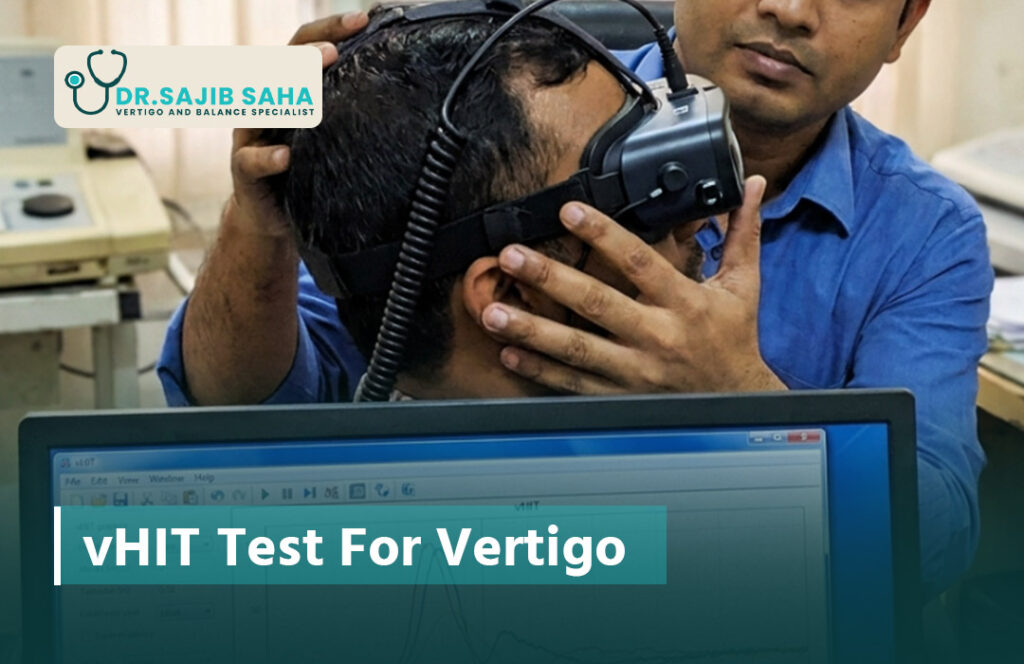
If you frequently experience vertigo, dizziness, imbalance, unsteady walking, or a spinning sensation, your doctor may recommend a vHIT test for vertigo. The Video Head Impulse Test, commonly called vHIT, is a modern vestibular test used to evaluate how well the balance organs in your inner ear are working.
Unlike a routine clinical examination, vHIT uses special video goggles with a high-speed camera and motion sensors to measure the relationship between your head movement and eye movement. The test mainly evaluates the vestibulo-ocular reflex (VOR), which helps keep your vision stable when your head moves.
A vHIT test can provide important information when a doctor is evaluating vertigo, dizziness, vestibular weakness, vestibular neuritis, labyrinth disorders, bilateral vestibular loss, and other balance problems.
However, vHIT is not a standalone test for every type of vertigo. Depending on your symptoms, a specialist may combine vHIT with other examinations such as VNG, hearing tests, positional testing, or posturography.
If you are looking for a proper evaluation of dizziness or balance problems, understanding what a vHIT test measures, how it is performed, and what the results mean can help you make an informed decision about your care.
What Is a vHIT Test?
vHIT stands for Video Head Impulse Test.
It is a specialized vestibular function test that evaluates the vestibulo-ocular reflex (VOR) during rapid, small head movements.
During the test, you wear lightweight video goggles while focusing on a fixed target. A specialist makes quick and unpredictable head movements while the camera records your eye movements.
The purpose is to determine whether your eyes remain properly focused on the target while your head moves.
A healthy vestibular system allows the eyes to move in the opposite direction of the head movement, keeping the image stable.
If one or more vestibular organs are not functioning properly, the eyes may temporarily move away from the target. The brain then makes a rapid corrective eye movement called a catch-up saccade.
This is one of the important findings that a vHIT test can detect.
Research has shown that video head impulse testing can identify peripheral vestibular deficits and detect both overt and covert corrective saccades that may not be easily seen during a routine bedside examination.
What Does vHIT Test for?
The main purpose of a vHIT test is to assess the function of the semicircular canals and the vestibulo-ocular reflex.
The vestibular system is located inside the inner ear and plays a major role in maintaining:
- Balance
- Spatial orientation
- Stable vision during head movement
- Coordination between the eyes and head
- Postural control
A vHIT may help identify evidence of vestibular weakness affecting one or both sides.
Depending on the equipment and testing protocol, vHIT can evaluate the function of the semicircular canals, including the horizontal and vertical canals.
Modern vHIT systems can assess all six semicircular canals individually.
This makes the test particularly useful when a specialist suspects a problem with the peripheral vestibular system.
What Is the Vestibulo-Ocular Reflex (VOR)?
To understand vHIT, it is useful to understand the vestibulo-ocular reflex, or VOR.
Imagine that you are walking while looking at a sign.
Your head moves slightly with every step, but your eyes need to remain focused on the sign. Your vestibular system detects the head movement and sends information to the brain.
The brain then produces an opposite eye movement.
This automatic response is the VOR.
For example, if your head moves to the right, your eyes should move to the left to keep the target stable.
When the VOR is functioning properly, you can move your head without your vision becoming excessively blurred or unstable.
When the vestibular system is weak, the VOR may not compensate adequately. This can lead to:
- Blurred or bouncing vision during movement
- Difficulty reading while walking
- Unsteadiness
- Dizziness
- Imbalance
- Oscillopsia
- Difficulty walking in dark environments
The vHIT measures this reflex quantitatively during rapid head movements.
Why Is vHIT Important for Vertigo Diagnosis?
Vertigo is not a single disease.
It is a symptom that can occur because of different conditions involving the inner ear, vestibular nerve, brain, or other systems involved in balance.
For example, vertigo may occur with:
- BPPV
- Vestibular neuritis
- Labyrinthitis
- Ménière’s disease
- Vestibular migraine
- Unilateral vestibular weakness
- Bilateral vestibular loss
- Other vestibular disorders
Because different conditions can cause similar symptoms, a specialist may need more than one examination.
A vHIT can provide objective information about vestibular function and may help determine whether there is evidence of peripheral vestibular weakness.
Your doctor may combine the vHIT findings with your symptoms, medical history, eye movement examination, hearing assessment, positional testing, and other vestibular tests.
For a broader overview, you can also read our guide on Vestibular Function Test in Bangladesh, which explains the different tests used to evaluate the balance system.
Who May Need a vHIT Test?
A doctor or vestibular specialist may recommend vHIT when a patient has symptoms suggesting a vestibular disorder.
Common reasons include:
1. Recurrent Vertigo
If you experience repeated spinning sensations, a specialist may perform vestibular testing to determine whether the inner-ear balance system is involved.
2. Persistent Dizziness
Dizziness that continues for weeks or repeatedly returns may require a detailed vestibular assessment.
3. Balance Problems
People who feel unsteady while walking or standing may require evaluation of their vestibular function.
4. Vestibular Neuritis
Vestibular neuritis can cause sudden, severe vertigo and imbalance. Vestibular testing may help evaluate vestibular function during the diagnostic process.
5. Suspected Vestibular Hypofunction
If one or both inner ears are not providing normal vestibular information, vHIT may help detect reduced vestibular function.
6. Unexplained Imbalance
When routine examinations do not adequately explain persistent imbalance, a specialist may recommend additional vestibular testing.
7. Oscillopsia
Some patients describe their vision as bouncing, moving, or becoming unstable when they walk or move their head. This can be associated with impaired vestibular function.
8. Follow-Up After Vestibular Problems
In some situations, vestibular testing may be used to monitor changes in vestibular function over time.
The exact tests required depend on the patient’s symptoms and clinical examination.
What Conditions Can vHIT Help Evaluate?
A vHIT may provide useful information in the assessment of several vestibular conditions.
vHIT and Vestibular Neuritis
Vestibular neuritis involves dysfunction of the vestibular nerve and can produce acute vertigo, nausea, and imbalance.
A reduced VOR response and corrective saccades may support the presence of peripheral vestibular dysfunction.
vHIT and Unilateral Vestibular Hypofunction
When one side of the vestibular system is weaker, vHIT may show reduced function on that side.
This information can be useful when planning further management or vestibular rehabilitation.
vHIT and Bilateral Vestibular Loss
When both vestibular systems are significantly impaired, patients may experience severe imbalance, difficulty walking in darkness, and visual instability during movement.
vHIT can help assess vestibular responses on both sides.
vHIT and Labyrinth Disorders
Certain inner-ear disorders can affect vestibular function. vHIT may be included as part of a broader vestibular assessment.
vHIT and Ménière’s Disease
Ménière’s disease can cause episodes of vertigo, hearing changes, tinnitus, and ear pressure.
vHIT may provide useful information about semicircular canal function, but it is not by itself a diagnostic test for Ménière’s disease.
Additional clinical and hearing-related evaluation may be necessary.
vHIT and BPPV
BPPV is one of the most common causes of positional vertigo.
However, vHIT is not usually the primary test for diagnosing BPPV.
A positional examination such as the Dix-Hallpike test or other appropriate positional testing is generally more relevant when symptoms are triggered by specific head positions.
This is an important distinction: not every patient with vertigo needs a vHIT test.
How Is the vHIT Test Done?
A vHIT test is generally performed while you are seated and wearing specialized video goggles.
The process usually includes the following steps.
Step 1: Wearing the vHIT Goggles
The specialist places lightweight goggles securely around your eyes.
The goggles contain a camera that records eye movements and sensors that measure head movement.
Step 2: Focusing on a Target
You will normally be asked to look at a fixed target, such as a dot or mark on a wall.
It is important to keep your eyes focused on the target during the test.
Step 3: Head Impulses
The examiner moves your head quickly in small, unpredictable movements.
These movements are designed to stimulate specific semicircular canals.
Step 4: Eye Movement Recording
The high-speed camera records your eye movements while motion sensors record the movement of your head.
Step 5: Computer Analysis
The software compares head velocity with eye velocity and calculates parameters such as VOR gain.
The specialist then reviews the traces and other findings together with your clinical history.
A typical vHIT assessment is relatively quick. One NHS patient-information resource lists approximately 20 minutes for the vHIT portion of balance testing, although the actual appointment time can vary by clinic and whether additional tests are performed.
Does vHIT Cause Dizziness?
Many patients worry that moving the head quickly during a vHIT test will cause severe vertigo.
The test is generally designed to use small, rapid head movements.
Some people may experience brief discomfort, dizziness, or nausea, especially if they already have significant vestibular symptoms.
However, the test is usually well tolerated.
A patient should tell the examiner if they feel unwell during the procedure.
Do not try to perform a vHIT on yourself at home by rapidly moving your head. Proper testing requires calibrated equipment, appropriate technique, and professional interpretation.
Is vHIT Test Painful?
The vHIT test is generally not painful.
You wear goggles while the examiner performs controlled head movements.
You may feel:
- Mild pressure from the goggles
- Temporary dizziness
- Mild nausea
- Eye fatigue
- Discomfort from repeated head movements
These sensations are usually temporary.
If you have neck problems, recent neck injury, severe mobility limitations, or another condition that could make rapid head movement unsafe, inform the specialist before testing.
How Long Does a vHIT Test Take?
The actual vHIT procedure is usually relatively short.
The complete appointment can take longer depending on:
- Number of canals tested
- Equipment used
- Whether calibration is required
- Whether the doctor performs additional vestibular tests
- Whether hearing tests are performed
- Whether a detailed clinical assessment is included
Some centers may complete the vHIT portion within around 10–20 minutes, while a complete balance assessment may take longer.
How to Prepare for a vHIT Test
One advantage of vHIT is that it usually requires less preparation than some other vestibular tests.
However, preparation instructions can vary between clinics.
Before your appointment:
- Follow the instructions provided by your clinic.
- Bring previous medical and vestibular test reports if available.
- Tell your doctor about current medications.
- Tell the examiner about recent ear problems or vestibular treatment.
- Inform the specialist about neck or cervical spine problems.
- Wear comfortable clothing.
- Avoid arriving dehydrated or exhausted.
- Follow any specific instructions given by the testing center.
Do not stop prescribed medication unless your doctor specifically tells you to do so.
Can I Eat Before a vHIT Test?
In many cases, special fasting is not required for a vHIT.
However, individual clinics may provide different instructions, especially when several vestibular tests are scheduled together.
Therefore, follow the preparation instructions given by the testing center.
If you are unsure, ask the clinic before your appointment.
What Are VOR Gain and Catch-Up Saccades?
Two important concepts in vHIT interpretation are VOR gain and catch-up saccades.
What Is VOR Gain?
VOR gain is a measurement that compares eye movement with head movement.
In simplified terms:
VOR Gain = Eye Velocity ÷ Head Velocity
If the eyes compensate appropriately for head movement, the gain is closer to the expected normal range.
A reduced VOR gain may indicate reduced vestibular function in the tested canal.
However, the exact interpretation depends on the testing system, protocol, age, calibration, and clinical context.
Therefore, patients should not diagnose themselves based on a single number from a vHIT report.
What Are Catch-Up Saccades?
A catch-up saccade is a rapid corrective eye movement that occurs when the eyes fail to remain accurately fixed on the target during a head movement.
There are two commonly discussed types:
- Overt saccades
- Covert saccades
An overt catch-up saccade occurs after the head movement.
A covert catch-up saccade occurs during the head movement and may be difficult to see with the naked eye.
The video component of vHIT helps identify these rapid eye movements.
What Does a Normal vHIT Result Mean?
A normal vHIT generally indicates that the tested vestibulo-ocular reflex responses are within the expected range for the testing protocol.
A normal result may suggest that the tested semicircular canals are functioning adequately.
However:
A normal vHIT does not mean that a patient cannot have vertigo.
This is extremely important.
Some conditions can cause vertigo without producing an abnormal vHIT.
For example, a patient with BPPV may have a normal vHIT because the primary problem involves displaced otoconia within a semicircular canal rather than generalized loss of canal function.
Similarly, vestibular migraine may require a broader clinical assessment.
Therefore, vHIT results must always be interpreted alongside symptoms and other examination findings.
What Does an Abnormal vHIT Result Mean?
An abnormal vHIT may indicate reduced function of one or more vestibular organs.
Possible findings may include:
- Reduced VOR gain
- Corrective catch-up saccades
- Asymmetry between sides
- Abnormal responses in particular semicircular canals
An abnormal result can provide important evidence of vestibular dysfunction.
However, an abnormal vHIT does not automatically identify the exact cause of the patient’s vertigo.
The specialist must interpret the result in combination with:
- Symptoms
- Duration of vertigo
- Triggering factors
- Hearing symptoms
- Eye movement findings
- Neurological examination
- Positional testing
- VNG or other vestibular tests
- Audiometry when appropriate
- Medical history
What If My vHIT Result Is Abnormal?
Do not panic if your vHIT report shows an abnormal finding.
An abnormal result is not a diagnosis by itself.
It is information that helps your specialist understand how your vestibular system is functioning.
Depending on the findings, your doctor may recommend:
- Additional vestibular tests
- Hearing evaluation
- Vestibular rehabilitation
- Treatment for an underlying vestibular disorder
- Positional maneuvers when BPPV is diagnosed
- Follow-up assessment
The treatment depends on the actual cause of your symptoms.
vHIT vs VNG: What Is the Difference?
Patients often ask whether vHIT or VNG is better for vertigo.
The answer is that these tests measure different aspects of vestibular function and may complement each other.
vHIT
vHIT primarily evaluates the vestibulo-ocular reflex during rapid head movements.
It can provide information about semicircular canal function at high-frequency head movements.
VNG
VNG, or Videonystagmography, uses specialized goggles to record eye movements during different vestibular and positional tests.
It can help evaluate nystagmus and other eye movement responses.
Your doctor may choose one test or combine several tests depending on your symptoms.
Therefore, vHIT is not simply a replacement for VNG.
Both can have an important role in a complete vestibular assessment.
Our website also provides information about Vestibular Tests for Chronic Dizziness, which explains why different vestibular tests may be required for persistent dizziness.
vHIT vs Caloric Test
The vHIT and caloric test both evaluate vestibular function, but they do so under different stimulation conditions.
vHIT
- Uses rapid head movements
- Evaluates the VOR
- Can assess individual semicircular canals
- Provides quantitative eye movement data
- Usually quick
- Does not require water or air stimulation of the ear
Caloric Testing
Caloric testing stimulates the vestibular system using temperature changes in the ear canal.
It evaluates vestibular responses under a much lower-frequency stimulation condition than vHIT.
Therefore, the two tests are not identical.
A patient can sometimes have different results on vHIT and caloric testing because they examine vestibular function under different conditions.
This is one reason why a specialist may order more than one vestibular test when the diagnosis is unclear.
vHIT vs Head Impulse Test
The Head Impulse Test (HIT) is the clinical bedside version of the head impulse examination.
The examiner moves the patient’s head rapidly while observing the eyes.
The problem is that some corrective eye movements are too fast or subtle for the human eye to detect.
The video Head Impulse Test (vHIT) adds a high-speed camera and motion sensors, allowing the system to quantify eye and head movement.
This makes vHIT more objective and allows the specialist to detect covert corrective saccades that may not be visible during a routine bedside HIT.
Is vHIT the Best Test for Vertigo?
There is no single “best test” for every patient with vertigo.
The appropriate test depends on the suspected cause.
For example:
| Condition or symptom | Commonly relevant evaluation |
| Positional vertigo | Dix-Hallpike and positional testing |
| Suspected vestibular weakness | vHIT and other vestibular tests |
| Chronic dizziness | Vestibular assessment based on symptoms |
| Hearing loss with vertigo | Hearing and vestibular evaluation |
| Suspected BPPV | Positional examination |
| Complex balance disorder | Comprehensive balance assessment |
| Persistent unexplained dizziness | Specialist evaluation and targeted testing |
This is why a complete clinical assessment is more valuable than choosing a test based only on an internet search.
Our article on Best Balance Test for Vertigo explains how different balance tests are selected according to the patient’s symptoms and suspected condition.
Can vHIT Diagnose Vertigo?
vHIT does not diagnose every type of vertigo by itself.
Instead, it provides objective information about vestibular function.
The final diagnosis may depend on a combination of:
Symptoms + Clinical Examination + Vestibular Testing + Hearing Assessment + Medical History
This distinction is important because “vertigo” describes a symptom, while conditions such as BPPV, vestibular neuritis, Ménière’s disease, vestibular migraine, and other vestibular disorders describe possible causes.
vHIT and Vestibular Rehabilitation
If vestibular testing identifies evidence of vestibular hypofunction, your specialist may consider Vestibular Rehabilitation Therapy (VRT) as part of the treatment plan.
VRT uses individualized exercises to help the brain adapt to changes in the vestibular system.
Depending on the condition, exercises may focus on:
- Gaze stabilization
- Balance training
- Habituation
- Walking and movement
- Coordination
- Functional activities
However, VRT is not automatically required for every person with vertigo.
For example, BPPV is commonly treated with appropriate repositioning maneuvers rather than simply prescribing a general balance exercise program.
You can learn more about Vestibular Rehabilitation Therapy in Bangladesh and how rehabilitation may be used for selected vestibular conditions.
What Happens After a vHIT Test?
After the test, your specialist will review the findings.
The next step depends on the results.
If the vHIT Is Normal
A normal result may lead the doctor to investigate other possible causes of dizziness or vertigo.
Additional evaluation may include:
- Positional testing
- VNG
- Audiometry
- Neurological assessment
- Migraine-related evaluation
- Other balance testing
If the vHIT Is Abnormal
The doctor may investigate:
- Unilateral vestibular weakness
- Bilateral vestibular dysfunction
- Vestibular neuritis
- Other peripheral vestibular conditions
- Possible neurological or technical factors affecting interpretation
Further testing may be recommended depending on the clinical picture.
Why You Should Not Interpret a vHIT Report Yourself
A vHIT report may contain graphs, gain values, saccade data, velocity curves, and other technical information.
It is tempting to search these numbers online and decide whether you have a vestibular disorder.
That can be misleading.
vHIT interpretation can be affected by:
- Poor goggle placement
- Calibration problems
- Inadequate head impulses
- Blinking
- Poor fixation
- Eye movement abnormalities
- Technical artifacts
- Incorrect analysis
- Existing neurological conditions
Published literature also describes technical and neurological factors that can affect vHIT interpretation.
Therefore, the report should be interpreted by a qualified clinician who understands vestibular testing.
Common Symptoms That May Lead to Vestibular Testing
You may need a professional assessment if you experience:
- Recurrent spinning sensation
- Frequent dizziness
- Loss of balance
- Unsteady walking
- Difficulty walking in darkness
- Visual instability while walking
- Nausea associated with vertigo
- Sudden episodes of imbalance
- Ear pressure
- Tinnitus
- Hearing changes
- Difficulty keeping your vision stable during head movement
- Persistent dizziness without a clear explanation
Not every symptom indicates an inner-ear disorder, which is why proper evaluation is important.
When Should You See a Vertigo Specialist?
You should consider seeing a qualified specialist if dizziness or vertigo is:
- Recurrent
- Persistent
- Getting worse
- Affecting your walking
- Affecting your work or daily activities
- Associated with hearing changes
- Associated with repeated falls
- Difficult to explain after routine treatment
A specialist can determine whether vestibular testing is appropriate.
If you are looking for a broader assessment, you can also explore our Balance Assessment in Dhaka guide.
vHIT Test for Vertigo in Bangladesh
In Bangladesh, patients with vertigo and balance disorders increasingly have access to specialized vestibular testing.
However, the most important factor is not simply finding a machine that performs vHIT.
The test should be performed using appropriate technique and interpreted by someone familiar with vestibular disorders.
A proper evaluation should begin with the patient’s symptoms and medical history.
Depending on the situation, the specialist may recommend:
- Clinical examination
- Positional testing
- vHIT
- VNG
- Audiometry
- Posturography
- Other vestibular assessments
The goal is not to perform every possible test.
The goal is to identify the right test for the right patient.
Where Can You Get a Vertigo Evaluation in Dhaka?
Dr. Sajib Saha provides specialized care for vertigo and balance disorders in Dhaka, including clinical assessment and advanced vestibular testing.
The clinic’s website describes services including vestibular testing, VNG, posturography, audiometric evaluation, and treatment for conditions such as vertigo, BPPV, Ménière’s disease, and vestibular disorders.
For appointment information, you can visit the Contact Dr. Sajib Saha page. The current website lists the Vertigo & Balance Center at Concept Tower, Green Road, Dhaka, along with appointment contact numbers.
Why Choose a Specialist for vHIT and Vertigo Evaluation?
Vertigo can have multiple causes.
A test result has value only when it is interpreted in the context of the patient’s complete clinical picture.
A specialist-led evaluation can help determine:
- Whether the symptoms are actually vertigo
- Whether the vestibular system is involved
- Which vestibular test is appropriate
- Whether hearing evaluation is necessary
- Whether the symptoms suggest BPPV
- Whether vestibular rehabilitation may be useful
- Whether another medical evaluation is required
Dr. Sajib Saha’s website describes his clinical focus as vertigo and balance disorders and lists more than a decade of experience in this area.
Frequently Asked Questions About vHIT Test for Vertigo
What does vHIT stand for?
vHIT stands for Video Head Impulse Test. It is a vestibular test that evaluates the vestibulo-ocular reflex during rapid head movements.
Is vHIT used for vertigo?
Yes. vHIT may be used as part of the evaluation of patients with vertigo, dizziness, imbalance, and suspected vestibular dysfunction.
Is the vHIT test painful?
No. vHIT is generally non-invasive and is not normally painful. Some patients may experience brief dizziness or discomfort during head movements.
How long does vHIT take?
The actual test is usually relatively short. The total appointment time depends on the clinic, equipment, calibration, and whether other vestibular tests are performed.
What does an abnormal vHIT mean?
An abnormal vHIT may indicate reduced function of one or more vestibular organs. The result must be interpreted alongside the patient’s symptoms and other clinical findings.
What is a normal vHIT result?
A normal vHIT generally indicates that the tested vestibulo-ocular reflex responses are within the expected range for the test protocol.
Can vHIT detect vestibular weakness?
Yes. vHIT can provide objective information about vestibular function and may detect reduced VOR responses associated with vestibular weakness.
Can vHIT diagnose BPPV?
vHIT is not usually the primary test used to diagnose BPPV. Positional testing is generally more important for identifying BPPV.
Is vHIT better than VNG?
Neither test is universally “better.” They assess different aspects of vestibular function and may complement each other.
Can I do a vHIT test at home?
A professional vHIT requires specialized equipment and appropriate testing technique. Do not attempt to reproduce the test by rapidly moving your head at home.
Does vHIT test the inner ear?
Yes. vHIT evaluates vestibular function associated with the semicircular canals of the inner ear by measuring the vestibulo-ocular reflex.
Can vHIT detect problems in both ears?
Yes. The test can evaluate vestibular responses from both sides and may help identify unilateral or bilateral vestibular dysfunction.
Does a normal vHIT mean I do not have vertigo?
No. A normal vHIT does not rule out every cause of vertigo. Conditions such as BPPV or vestibular migraine may require other diagnostic approaches.
Is vHIT safe?
vHIT is generally considered a safe and well-tolerated vestibular examination when performed appropriately. Patients should inform the clinician about relevant neck or medical problems before testing.
Should I stop my medicine before vHIT?
Do not stop prescribed medication without medical advice. Follow the preparation instructions provided by the testing center or your doctor.
Final Thoughts: Is vHIT Test Useful for Vertigo?
The vHIT test for vertigo is an important modern tool for evaluating vestibular function.
It measures the vestibulo-ocular reflex, records eye movements during rapid head movements, and can provide objective information about the function of the semicircular canals.
It can be particularly useful when a specialist suspects vestibular weakness or another peripheral vestibular disorder.
However, vHIT should not be treated as a universal test for every type of dizziness.
The most accurate approach is to combine:
Detailed history + Clinical examination + Appropriate vestibular tests + Hearing assessment when needed + Specialist interpretation
If you have persistent or recurrent vertigo, dizziness, imbalance, or visual instability during head movement, do not rely only on online symptom searches. A proper assessment can help identify the likely cause and guide the appropriate treatment pathway.
For a complete evaluation of vertigo and balance problems in Dhaka, you can consult Dr. Sajib Saha, Vertigo & Balance Disorder Specialist.
Book an Appointment / Contact Dr. Sajib Saha
Important Medical Disclaimer
This article is provided for general educational and informational purposes. It does not replace an in-person medical examination, diagnosis, or treatment plan. The need for vHIT or any other vestibular test depends on the patient’s symptoms and clinical findings. If you experience sudden severe dizziness with new neurological symptoms such as weakness, difficulty speaking, severe coordination problems, or other emergency symptoms, seek urgent medical evaluation.