
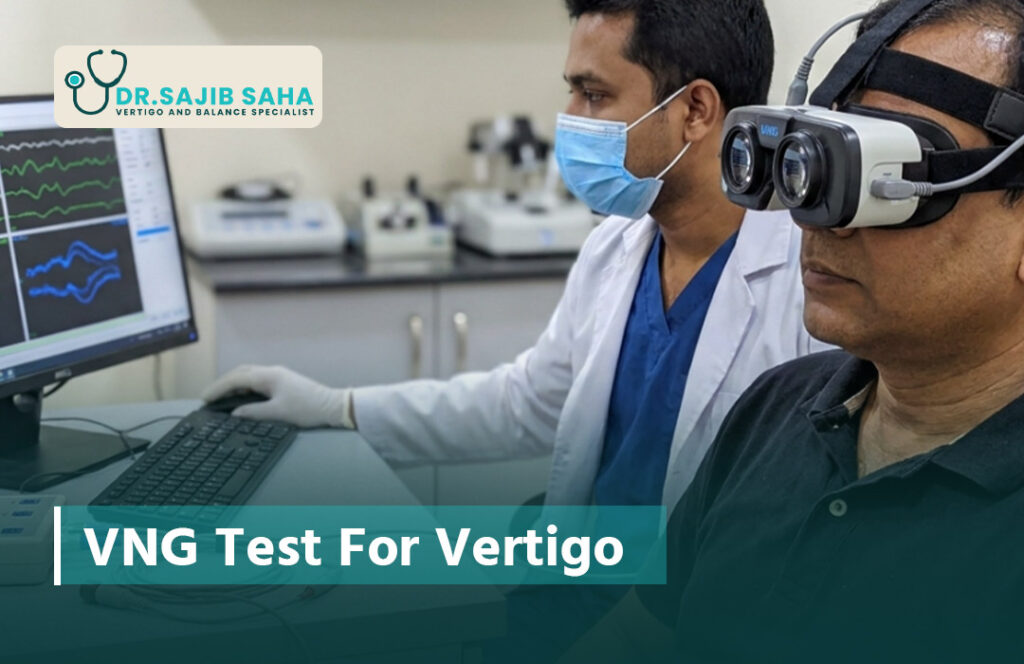
If you experience frequent vertigo, dizziness, spinning sensations, imbalance, nausea, or difficulty walking, your doctor may recommend a VNG test for vertigo.
VNG stands for Videonystagmography. It is an advanced vestibular test that uses specialized goggles with cameras to record and analyze your eye movements. Because eye movements are closely connected to the body’s balance system, VNG can provide important information about how the inner ear, vestibular system, and brain work together to maintain balance.
VNG is commonly used when a doctor needs more detailed information about the possible cause of dizziness or vertigo. Depending on your symptoms, it may be used along with other examinations such as hearing tests, positional testing, vHIT, posturography, or other vestibular assessments.
If you are searching for VNG Test for Vertigo in Bangladesh, this guide explains what VNG is, how the test is performed, what it can detect, how to prepare, what normal and abnormal results mean, and how VNG differs from other balance tests.
What Is a VNG Test?
VNG stands for Videonystagmography.
It is a diagnostic test that records eye movements using specialized video goggles.
The vestibular system in your inner ear helps your brain understand head movement and maintain balance. When the vestibular system is disturbed, it can produce abnormal eye movements called nystagmus.
During VNG testing, infrared cameras inside the goggles record your eye movements while you perform different tasks or your head is placed in different positions.
The recorded eye movements can help a specialist evaluate whether there is evidence of a problem involving the vestibular system.
VNG is therefore an important part of a comprehensive evaluation for patients with vertigo, dizziness, balance problems, and suspected vestibular disorders.
Your website already identifies VNG as one of the advanced diagnostic tools used for vestibular assessment.
What Does VNG Test for?
VNG evaluates several aspects of the balance system through eye movement responses.
Depending on the VNG system and clinical protocol, testing may evaluate:
- Eye movement control
- Spontaneous nystagmus
- Gaze-related eye movements
- Positional nystagmus
- Visual tracking
- Optokinetic responses
- Vestibular responses
- Caloric responses
- Possible unilateral vestibular weakness
The exact components performed depend on the patient’s symptoms and the specialist’s clinical assessment.
VNG does not simply ask whether you feel dizzy. It provides objective recordings of eye movements that can help the clinician understand how your vestibular system is responding.
Why Is VNG Important for Vertigo?
Vertigo is a symptom rather than one single disease.
Several conditions can cause similar symptoms, including:
- BPPV
- Vestibular neuritis
- Labyrinthitis
- Ménière’s disease
- Vestibular migraine
- Unilateral vestibular hypofunction
- Bilateral vestibular dysfunction
- Other vestibular disorders
A patient may describe all of these conditions simply as “মাথা ঘোরা” or “vertigo,” even though the underlying causes can be very different.
That is why proper evaluation is important.
VNG can help a specialist identify abnormal eye movement patterns and assess vestibular function as part of a broader diagnostic process.
Your existing article on Vestibular Test for Chronic Dizziness also explains that VNG can help identify which side of the vestibular system may be affected and distinguish possible inner-ear causes from neurological causes.
How Does VNG Work?
The relationship between the inner ear and eye movements is the foundation of VNG testing.
Your vestibular system detects movement of your head.
The information travels through the vestibular nerve to the brain.
The brain then coordinates eye movements to help maintain stable vision.
When the vestibular system is disturbed, this coordination may become abnormal.
These abnormal eye movements can sometimes be seen as nystagmus.
The VNG goggles use cameras to record these eye movements with much greater precision than simply observing the patient’s eyes.
The recorded information is then analyzed by specialized software and interpreted by a qualified clinician.
What Is Nystagmus?
Nystagmus is an involuntary rhythmic movement of the eyes.
Depending on the underlying cause, nystagmus can move:
- Horizontally
- Vertically
- Rotationally
The direction, timing, intensity, and pattern of nystagmus can provide useful diagnostic information.
During VNG, the cameras record these movements so the specialist can analyze them objectively.
Nystagmus can occur for different reasons, so its presence does not automatically mean that a patient has a specific disease.
This is why VNG results must be interpreted together with symptoms and other examination findings.
Who May Need a VNG Test?
A doctor may recommend VNG when a patient has symptoms that suggest a vestibular or balance disorder.
Common reasons include:
Persistent Dizziness
If dizziness continues for weeks or months, vestibular testing may help identify whether the balance system is involved.
Recurrent Vertigo
Repeated spinning episodes may require objective vestibular assessment.
Unexplained Imbalance
Patients who frequently feel unsteady while walking or standing may benefit from a balance evaluation.
Suspected Inner Ear Disorder
VNG can be useful when symptoms suggest dysfunction of the vestibular system.
Hearing Problems With Vertigo
Vertigo accompanied by hearing loss, tinnitus, or ear pressure may require both vestibular and hearing evaluation.
Vestibular Neuritis
VNG may provide information about vestibular function following suspected vestibular neuritis.
Ménière’s Disease
Patients with episodic vertigo and hearing-related symptoms may require vestibular and audiological testing as part of a broader evaluation.
Chronic Dizziness
Persistent dizziness that does not improve with routine treatment may require a more detailed vestibular workup.
What Conditions Can VNG Help Evaluate?
VNG can provide useful information when evaluating several vestibular conditions.
1. BPPV
Benign Paroxysmal Positional Vertigo (BPPV) is one of the most common causes of positional vertigo.
People with BPPV may experience brief spinning when:
- Turning in bed
- Looking up
- Looking down
- Getting out of bed
- Changing head position
Positional testing can provoke characteristic eye movements that help identify BPPV.
However, VNG is not always required to diagnose straightforward BPPV. A trained clinician can often diagnose it through appropriate positional examination.
2. Vestibular Neuritis
Vestibular neuritis can cause sudden severe vertigo and imbalance.
VNG may help document vestibular dysfunction and contribute to the overall diagnostic assessment.
3. Labyrinthitis
Labyrinthitis can involve vestibular symptoms along with hearing-related symptoms.
Depending on the clinical presentation, VNG and hearing assessment may be included in the evaluation.
4. Ménière’s Disease
Ménière’s disease can cause episodes of vertigo, fluctuating hearing loss, tinnitus, and a feeling of pressure or fullness in the ear.
VNG may be part of the diagnostic workup, but it cannot diagnose Ménière’s disease by itself.
5. Vestibular Hypofunction
If the vestibular system is weaker on one side, vestibular testing may provide evidence of that dysfunction.
This information can help guide further treatment and rehabilitation.
6. Other Vestibular Disorders
VNG can also contribute information when a clinician is evaluating other causes of dizziness and balance dysfunction.
What Happens During a VNG Test?
The exact procedure varies between clinics, but a typical VNG evaluation may include several stages.
Step 1: Medical History
The specialist may ask about:
- Your dizziness
- Duration of symptoms
- Triggers
- Hearing changes
- Tinnitus
- Previous ear problems
- Head injuries
- Migraine history
- Previous vestibular treatment
- Current medications
This information helps determine which parts of the VNG examination are appropriate.
Step 2: Wearing VNG Goggles
You will wear specialized goggles around your eyes.
The goggles contain cameras that record eye movements.
The goggles must fit properly so that the camera can accurately track your eyes.
Step 3: Eye Movement Testing
You may be asked to look at different targets or follow moving objects.
This allows the system to evaluate different aspects of eye movement control.
Step 4: Positional Testing
The specialist may move your head or body into different positions.
The goal is to observe whether particular positions trigger dizziness or abnormal eye movements.
This can be especially useful when BPPV or another positional vestibular disorder is suspected.
Step 5: Caloric Testing
In some VNG protocols, caloric testing is included.
Warm or cool air or water is introduced into the ear canal under controlled conditions.
This changes the temperature near the inner ear and stimulates the vestibular system.
The resulting eye movements are recorded by the VNG goggles.
Caloric testing can provide information about the function of each side of the vestibular system.
Step 6: Result Analysis
The recorded eye movements are analyzed.
The specialist then interprets the results alongside your symptoms, medical history, and other test findings.
What Is the Caloric Test in VNG?
One of the most important parts of some VNG examinations is caloric testing.
Caloric testing evaluates vestibular responses by stimulating each ear separately using controlled temperature changes.
The stimulation produces a predictable vestibular response and associated eye movements.
The VNG system records these eye movements.
This can help the specialist compare the function of the two sides.
Caloric testing is different from vHIT because the two tests stimulate the vestibular system under different conditions.
This is one reason why a specialist may use both tests in selected patients.
Is VNG Test Painful?
VNG is generally non-invasive and is not considered a painful test.
However, some parts of the test can temporarily make you feel dizzy.
Possible sensations include:
- Dizziness
- Spinning
- Nausea
- Mild discomfort
- Temporary imbalance
- Eye fatigue
Caloric testing can be particularly likely to produce temporary dizziness because it deliberately stimulates the vestibular system.
These symptoms usually settle after the stimulation ends.
Tell the examiner if you feel very uncomfortable during the test.
How Long Does a VNG Test Take?
The duration depends on the type of VNG examination being performed.
A simple eye movement and positional assessment may take less time than a complete VNG evaluation that includes caloric testing.
The appointment can therefore vary depending on:
- Number of tests
- Clinic protocol
- Whether caloric testing is included
- Whether hearing tests are performed
- Whether additional vestibular assessments are needed
Your clinic should provide the expected appointment duration when you schedule the test.
How to Prepare for a VNG Test
Proper preparation can be important because certain factors may affect vestibular test results.
Your clinic may provide specific instructions before the appointment.
Depending on the protocol, you may be asked about:
- Medications
- Alcohol use
- Caffeine
- Smoking
- Food intake
- Cosmetics around the eyes
Follow the exact instructions provided by the testing center.
Important Medication Warning
Do not stop prescription medication on your own.
Some medications can influence vestibular responses, but whether a medication should be temporarily withheld depends on your individual situation and the test protocol.
Always ask the specialist or testing center before changing medication.
Can You Eat Before a VNG Test?
This depends on the clinic and the specific VNG protocol.
Some centers may recommend avoiding food for a certain period before testing because caloric stimulation can cause nausea.
Other clinics may provide different instructions.
Therefore, do not assume that fasting is required.
Follow the preparation instructions provided by your testing center.
Can You Drive After a VNG Test?
Some people experience temporary dizziness or imbalance after vestibular testing, especially when caloric testing is included.
For this reason, it may be safer to arrange transportation home rather than planning to drive immediately afterward.
Ask your clinic about its specific post-test recommendations.
What Is a Normal VNG Result?
A normal VNG result generally means that the recorded eye movement responses fall within the expected range for the test performed.
Depending on the examination, a normal result may indicate:
- Appropriate eye movement responses
- No significant abnormal spontaneous nystagmus
- No clinically significant positional abnormalities
- Expected vestibular responses
- No significant evidence of unilateral weakness on the relevant test
However, the definition of “normal” depends on the specific test, equipment, laboratory reference values, and clinical context.
A normal VNG does not mean that every possible cause of dizziness has been ruled out.
What Does an Abnormal VNG Result Mean?
An abnormal VNG result may indicate that something in the vestibular or eye movement system requires further evaluation.
Possible findings may include:
- Abnormal nystagmus
- Abnormal positional responses
- Abnormal tracking
- Abnormal vestibular responses
- Evidence of unilateral weakness
- Other atypical eye movement patterns
An abnormal result does not automatically tell you exactly which disease you have.
The specialist must consider the complete clinical picture.
What Is Unilateral Weakness in VNG?
A VNG examination may identify evidence that one vestibular system is responding less strongly than the other.
This is often described as unilateral vestibular weakness or unilateral weakness.
It may indicate reduced peripheral vestibular function on one side.
However, the result must be interpreted carefully.
The specialist may compare VNG findings with:
- Symptoms
- vHIT results
- Hearing test results
- Clinical examination
- Medical history
- Other vestibular tests
Can VNG Diagnose BPPV?
VNG can help document the eye movements associated with positional testing.
However, VNG is not always necessary to diagnose BPPV.
BPPV is usually evaluated through a detailed positional examination.
If the patient’s symptoms and positional eye movements strongly indicate BPPV, the clinician may proceed with an appropriate canalith repositioning maneuver.
Your existing Best Balance Test for Vertigo article already explains that positional testing, particularly the Dix-Hallpike test, plays an important role in evaluating BPPV.
Can VNG Detect Inner Ear Problems?
VNG can provide useful evidence about vestibular function.
However, “inner ear problem” is a broad term.
The inner ear contains both hearing and balance structures.
A VNG primarily evaluates vestibular function through eye movement responses.
For this reason, patients with vertigo and hearing symptoms may also need audiometry or other hearing tests.
Your website specifically lists audiometric evaluation alongside VNG and posturography as part of comprehensive vestibular assessment.
VNG vs vHIT: What Is the Difference?
Patients often search for VNG vs vHIT when trying to understand which test is better.
The two tests are different.
VNG
VNG records eye movements during several types of vestibular and eye movement testing.
Depending on the protocol, it can include:
- Eye movement testing
- Positional testing
- Caloric testing
- Other vestibular assessments
vHIT
vHIT stands for Video Head Impulse Test.
It evaluates the vestibulo-ocular reflex during rapid head movements and provides information about semicircular canal function.
Which Is Better?
There is no universal answer.
The most appropriate test depends on:
- Your symptoms
- Suspected diagnosis
- Clinical examination
- Previous test results
- Hearing symptoms
- Whether the specialist needs low-frequency or high-frequency vestibular information
In some patients, VNG and vHIT can complement each other.
VNG vs Caloric Test
A common misconception is that VNG and caloric testing are completely separate tests.
In many clinical settings, caloric testing can be performed as one component of a VNG examination.
VNG refers primarily to the video-based recording and analysis of eye movements, while caloric testing is a specific method of stimulating the vestibular system.
Therefore:
VNG = the recording/analysis system and examination protocol
Caloric testing = a specific vestibular stimulation test that may be included in VNG
This distinction is useful when comparing vestibular tests.
VNG vs Dix-Hallpike Test
The Dix-Hallpike test is primarily used to evaluate positional vertigo, especially suspected posterior-canal BPPV.
VNG is broader and can include multiple components.
A specialist may use the Dix-Hallpike test alone or combine positional testing with VNG depending on the patient’s symptoms and the diagnostic situation.
VNG vs Posturography
These tests answer different questions.
VNG primarily evaluates eye movements and vestibular-related responses.
Posturography evaluates how well you maintain balance under different sensory conditions.
Your website lists posturography as another advanced diagnostic tool for evaluating balance and fall risk.
In complex balance disorders, more than one test may be necessary.
Can VNG Detect Vestibular Migraine?
VNG may show abnormalities in some patients with vestibular migraine, but VNG does not independently diagnose vestibular migraine.
Vestibular migraine is primarily diagnosed based on the patient’s clinical history and established diagnostic criteria.
A normal VNG does not rule out vestibular migraine.
Similarly, an abnormal VNG does not automatically mean that vestibular migraine is the cause.
Can VNG Detect Ménière’s Disease?
VNG can contribute information to the evaluation of a patient suspected of having Ménière’s disease.
However, diagnosis is based on the complete clinical picture, including symptoms such as:
- Episodic vertigo
- Hearing changes
- Tinnitus
- Ear fullness
Hearing evaluation is particularly important when Ménière’s disease is suspected.
Can VNG Detect Vestibular Neuritis?
VNG can provide evidence of vestibular dysfunction in patients with vestibular neuritis.
The findings must be interpreted alongside the patient’s symptoms and other vestibular examinations.
In some cases, additional testing such as vHIT may provide complementary information.
Does VNG Show Which Ear Has the Problem?
Certain VNG components, especially caloric testing, can compare vestibular responses from the two sides.
This may provide evidence of unilateral vestibular weakness.
However, identifying which ear is involved and determining the underlying disease are not always the same thing.
A specialist must interpret the complete pattern of findings.
What Happens After a VNG Test?
The next step depends on your symptoms and results.
If the VNG Is Normal
Your doctor may consider other possible causes of dizziness.
Depending on your symptoms, further evaluation may include:
- vHIT
- Hearing assessment
- Positional testing
- Posturography
- Neurological evaluation
- Migraine-related assessment
- Other medical investigations
If the VNG Is Abnormal
Your specialist may recommend additional testing or treatment based on the suspected cause.
Possible treatment approaches can include:
- Canalith repositioning maneuvers
- Vestibular rehabilitation
- Medication when appropriate
- Hearing-related management
- Lifestyle modifications
- Follow-up vestibular testing
Treatment should target the underlying condition rather than simply treating the symptom of dizziness.
VNG and Vestibular Rehabilitation Therapy
Vestibular rehabilitation therapy, or VRT, is an exercise-based treatment approach used for selected vestibular disorders.
If testing identifies vestibular hypofunction or another condition that may benefit from rehabilitation, a specialist may develop an individualized exercise program.
VRT may include:
- Gaze stabilization
- Balance exercises
- Habituation exercises
- Walking exercises
- Head movement exercises
- Functional balance training
Your website provides a dedicated resource on Vestibular Rehabilitation Therapy in Bangladesh, where VNG is described as part of the diagnostic process before rehabilitation in appropriate patients.
VNG Test Cost in Bangladesh
The VNG test cost in Bangladesh can vary depending on the clinic, equipment, test components, and whether additional vestibular assessments are performed.
The total cost may depend on whether the examination includes:
- Basic VNG
- Positional testing
- Caloric testing
- Additional vestibular tests
- Audiometry
- Consultation
- Other balance assessments
Because prices can change, patients should confirm the current fee directly with the testing center before booking.
It is better to compare the scope of the test and professional interpretation, rather than choosing a clinic based only on the lowest price.
VNG Test in Dhaka
Patients searching for a VNG test in Dhaka should look for a center that provides appropriate vestibular assessment and professional interpretation.
Dr. Sajib Saha’s website lists VNG among the advanced diagnostic services offered for patients with vertigo and balance disorders.
The clinic’s current contact information lists its Vertigo & Balance Center at:
Concept Tower, 3rd Floor, Room 337 & 338
68–69, Green Road, Dhaka-1205
The website currently lists appointment phone numbers 01915 88 66 55 and 01915 44 33 66.
Patients should confirm current availability, test requirements, and pricing before visiting.
When Should You Get a VNG Test?
A VNG test may be considered when you have:
- Recurrent vertigo
- Persistent dizziness
- Unexplained imbalance
- Frequent falls or near-falls
- Vertigo with hearing changes
- Tinnitus with dizziness
- Suspected vestibular neuritis
- Suspected vestibular hypofunction
- Chronic balance problems
- Symptoms that have not improved with routine treatment
However, the decision to perform VNG should be made based on a proper clinical evaluation.
When Is VNG Not Necessary?
Not every person with dizziness needs VNG.
For example, a patient with a straightforward presentation of BPPV may be diagnosed through appropriate positional testing and treated immediately.
Similarly, some patients may need a hearing test, vHIT, neurological evaluation, imaging, or another assessment instead.
The goal of vestibular testing is not to perform every available test.
The goal is to choose the right test based on the patient’s symptoms and suspected diagnosis.
Questions to Ask Before Getting a VNG Test
Before undergoing VNG, you can ask the clinic:
- Why do I need a VNG test?
- Which parts of the VNG will be performed?
- Will caloric testing be included?
- Do I need to change any medication?
- Can I eat before the test?
- How long will the appointment take?
- Should someone accompany me?
- When will I receive the results?
- Will the results be explained by a specialist?
- Do I need additional vestibular or hearing tests?
These questions can help you understand what the test involves before your appointment.
Frequently Asked Questions About VNG Test for Vertigo
What is VNG in vertigo?
VNG, or Videonystagmography, is a vestibular test that records eye movements using specialized video goggles to help evaluate the balance system.
Is VNG test painful?
No. VNG is generally non-invasive and not painful, although some parts of the test may temporarily cause dizziness or nausea.
How long does a VNG test take?
The duration varies depending on the examination protocol and whether caloric testing or other vestibular tests are included.
What does an abnormal VNG mean?
An abnormal VNG may indicate an abnormal eye movement or vestibular response. It does not automatically identify one specific disease.
Can VNG diagnose vertigo?
VNG can provide important diagnostic information, but it does not independently diagnose every cause of vertigo. Diagnosis requires clinical history and examination.
Can VNG detect BPPV?
VNG can record eye movements during positional testing, which may support the assessment of BPPV. However, BPPV can often be diagnosed through appropriate positional examination without a full VNG.
Is VNG better than vHIT?
Neither is universally better. VNG and vHIT evaluate different aspects of vestibular function and may be complementary.
Is VNG test safe?
VNG is generally well tolerated. Temporary dizziness or nausea may occur, particularly during caloric testing.
Can I drive after VNG?
Some people experience temporary dizziness after testing. Ask your clinic whether you should arrange transportation home.
Can VNG detect inner ear problems?
VNG can provide evidence about vestibular function, but it does not evaluate every structure or disease of the inner ear. Hearing tests may also be necessary.
Does VNG test both ears?
Some components of VNG, particularly caloric testing, can compare vestibular responses from the two ears.
Can VNG detect vestibular weakness?
Yes. Certain VNG components can provide evidence of unilateral vestibular weakness.
Can a normal VNG still mean I have vertigo?
Yes. A normal VNG does not rule out every cause of vertigo, dizziness, or balance problems.
Do I need VNG for every type of dizziness?
No. The appropriate test depends on the symptoms and suspected cause.
Final Thoughts
The VNG test for vertigo is an important diagnostic tool for evaluating dizziness, vertigo, nystagmus, and vestibular function.
By recording eye movements during controlled visual, positional, and vestibular stimulation, VNG can provide objective information that may not be available from symptoms alone.
However, VNG should not be considered a standalone test for every type of vertigo.
The most effective diagnostic approach is usually:
Patient history + Clinical examination + Appropriate vestibular testing + Hearing assessment when required + Specialist interpretation
If you have recurrent vertigo, chronic dizziness, imbalance, tinnitus, hearing changes, or unexplained balance problems, a specialist can determine whether VNG or another vestibular test is appropriate.
Dr. Sajib Saha’s clinic provides advanced vestibular assessment, including VNG, posturography, and audiometric evaluation, as part of its vertigo and balance care.
For appointments, you can use the site’s appointment page or contact page.
Important Medical Disclaimer
This article is for general educational purposes and does not replace a medical examination or professional diagnosis. The need for VNG testing depends on the patient’s symptoms and clinical findings. If dizziness or vertigo occurs with sudden weakness, difficulty speaking, severe coordination problems, loss of consciousness, severe new headache, or other potentially serious neurological