
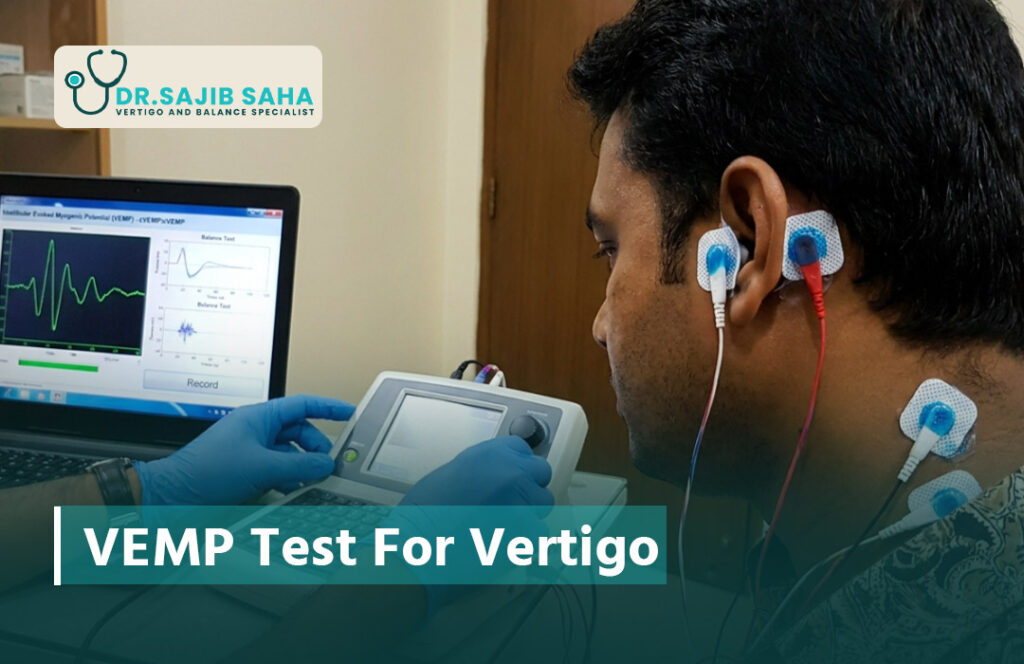
If you have been living with recurring vertigo, unexplained dizziness, or a spinning sensation that will not go away, you have probably already been told that “finding the cause” is the first step to real treatment. One of the most valuable tools I use to find that cause is the VEMP test, short for Vestibular Evoked Myogenic Potentials.
Many patients have never heard of this test before their first visit, so in this article I want to walk you through what a VEMP test actually is, how it works, what it can diagnose, and how it fits alongside other vestibular tests such as VNG and vHIT. By the end, you will understand exactly why your specialist may recommend it and what to expect on the day of your assessment.
If you are already experiencing symptoms and want to skip ahead, you can book an appointment directly.
What Is a VEMP Test?
The VEMP test is an electrophysiological test that measures how specific parts of your inner ear, called the otolith organs, and their connected nerve pathways respond to sound or vibration. Instead of looking at your eye movements the way a VNG or vHIT test does, a VEMP test records tiny muscle responses generated when your ear is stimulated with a calibrated sound or vibration signal.
There are two types of VEMP testing, and depending on your symptoms, one or both may be used:
- cVEMP (Cervical VEMP): Records a response from the neck muscle and mainly evaluates the saccule and the inferior vestibular nerve pathway.
- oVEMP (Ocular VEMP): Records a response from muscles beneath the eyes and mainly evaluates the utricle and the superior vestibular nerve pathway.
Together, cVEMP and oVEMP give a more complete picture of otolith organ function than either test alone, which is why both are often performed in the same session.
Why Vertigo Patients May Need a VEMP Test
Vertigo has many possible causes, and not every case comes from the same part of the inner ear. While tests like VNG and vHIT focus on the semicircular canals, a VEMP test focuses specifically on the otolith organs, which sense gravity and linear movement. This makes it especially useful when your symptoms suggest a problem that other tests cannot fully explain.
A VEMP test may be recommended if you are experiencing:
- Vertigo triggered or worsened by loud sounds or pressure changes
- Dizziness alongside fluctuating hearing loss or ear fullness, which can point toward Ménière’s disease
- Unexplained imbalance that has not been resolved by earlier testing
- Symptoms suggestive of a rare but important condition called superior semicircular canal dehiscence syndrome
If any of this sounds familiar, it is worth discussing your symptoms in detail during a consultation on the vertigo treatment page, where I explain how a proper diagnostic pathway is built around your specific symptoms rather than a one-size-fits-all approach.
What Conditions Can a VEMP Test Help Diagnose?
VEMP testing does not work in isolation. Results are always interpreted together with your symptoms, medical history, clinical examination, and other vestibular investigations. With that in mind, VEMP results can contribute meaningfully to the evaluation of:
- Ménière’s disease, particularly when fluctuating hearing loss and vertigo attacks are present. You can read more about long-term management on my Ménière’s disease treatment page.
- Superior semicircular canal dehiscence syndrome (SSCD), a structural inner ear condition that can cause sound-induced dizziness.
- Vestibular neuritis, especially when there is a need to understand which specific nerve pathways have been affected.
- Other otolith organ or vestibular nerve pathway disorders that fall under the broader umbrella of vestibular disorders.
It is important to understand that a VEMP test result is not diagnostic on its own. I use it as one piece of a larger clinical picture, alongside a detailed history, physical examination, and, when needed, complementary tests.
How the VEMP Test Is Performed
A VEMP test is straightforward and does not require any special sedation or preparation on your part. Here is what typically happens during the assessment:
- Electrode placement. Small surface electrodes are placed on your neck for cVEMP, and beneath your eyes for oVEMP.
- Sound or vibration stimulus. Calibrated sound is delivered through headphones, or a vibration stimulus is applied, while you are asked to either turn your head or look upward, depending on the test type.
- Muscle response recording. The electrodes pick up the small muscle responses generated by your otolith organs and vestibular nerve pathways in reaction to the stimulus.
- Review of results. The recorded amplitude, latency, and symmetry between your two ears are reviewed alongside your full clinical history.
The full assessment usually takes around 20 to 30 minutes, and most patients find the test easy to sit through since it does not involve any needles or injections.
Is the VEMP Test Painful or Safe?
This is one of the questions I hear most often, and the honest answer is that VEMP testing is non-invasive and generally painless. The electrodes rest on the surface of your skin, and the sound or vibration stimuli used are calibrated to safe clinical levels. Most patients describe feeling nothing more than the headphones and the sensation of the stimulus itself. There is no recovery time needed, and you can resume your normal activities immediately after the test.
VEMP Test vs Other Vestibular Tests
Because vertigo can originate from several different structures in the inner ear, I often use more than one type of test to build a complete picture. Here is how VEMP compares with two other commonly used vestibular tests:
- VNG test for vertigo: VNG evaluates eye movements to assess the semicircular canals and central vestibular pathways, and is especially useful for conditions like BPPV.
- vHIT test for vertigo: vHIT specifically measures the vestibulo-ocular reflex using video goggles and rapid head movements, focusing on the semicircular canals at high frequencies.
VEMP, by contrast, is the main test that looks specifically at otolith organ function rather than the semicircular canals. In many patients with persistent or unclear symptoms, a combination of these tests, along with a broader vestibular test for chronic dizziness, gives a far more reliable diagnosis than any single test used alone.
Who Should Consider a VEMP Test?
You may be a good candidate for VEMP testing if:
- You have already had a general evaluation for dizziness or imbalance but still do not have a clear answer
- Your symptoms include hearing changes, ear pressure, or sound-triggered dizziness
- You are being evaluated for Ménière’s disease or a suspected structural inner ear condition
- Your specialist wants a more complete picture of your otolith organ and vestibular nerve function alongside other tests such as VNG or vHIT
If you recognize these patterns in your own symptoms, the safest next step is a proper clinical evaluation rather than guessing at the cause. You can also learn more about how various vestibular and balance disorders are diagnosed and treated on my site.
What Happens After Your VEMP Test?
Once your VEMP results are ready, I review them alongside your full history, your other test results if applicable, and your physical examination findings. From there, we discuss a treatment plan tailored to the specific cause identified. Depending on your diagnosis, this may involve medication, canalith repositioning procedures for conditions like BPPV, long-term Ménière’s disease management, or a structured vestibular rehabilitation program.
Why Choose Dr. Sajib Saha for Your VEMP Test in Dhaka
Choosing the right specialist matters just as much as choosing the right test. With over a decade of clinical experience focused specifically on vertigo and balance disorders, I have built my practice around accurate diagnosis first, followed by a personalized, evidence-based treatment plan. My clinic is VNG and VRT certified, and I have helped a large number of patients across Dhaka work through persistent dizziness, spinning sensations, and unsteadiness.
You can read more about my background and clinical focus on the experience page, or reach out directly through the contact page if you have questions before booking.
Frequently Asked Questions
What is the difference between cVEMP and oVEMP? cVEMP records a response from the neck muscle and mainly evaluates the saccule and inferior vestibular nerve pathway. oVEMP records a response from muscles beneath the eyes and mainly evaluates the utricle and superior vestibular nerve pathway. Both are often performed together for a complete assessment.
Is the VEMP test painful? No. VEMP testing is non-invasive and generally painless. Electrodes are placed on the skin and the stimuli are delivered through headphones or a vibration device.
How long does a VEMP test take? A full VEMP assessment usually takes approximately 20 to 30 minutes.
Can a VEMP test diagnose Ménière’s disease on its own? No single test diagnoses Ménière’s disease by itself. VEMP results contribute useful information, but they are always interpreted together with your symptoms, medical history, clinical examination, and other vestibular investigations.
Do I need a referral to get a VEMP test? You do not need a referral. You can book directly and we will determine during your consultation whether a VEMP test, another vestibular test, or a combination is the right diagnostic pathway for you.
Book Your VEMP Test in Dhaka Today
Living with unexplained vertigo or dizziness can be exhausting, especially when previous tests have not given you a clear answer. A VEMP test may be the missing piece that finally identifies what is happening inside your inner ear. If your symptoms include sound-triggered dizziness, fluctuating hearing loss, or persistent imbalance, do not wait for things to get worse.
Book your appointment with Dr. Sajib Saha today and take the first step toward an accurate diagnosis and a treatment plan built around your specific condition.